
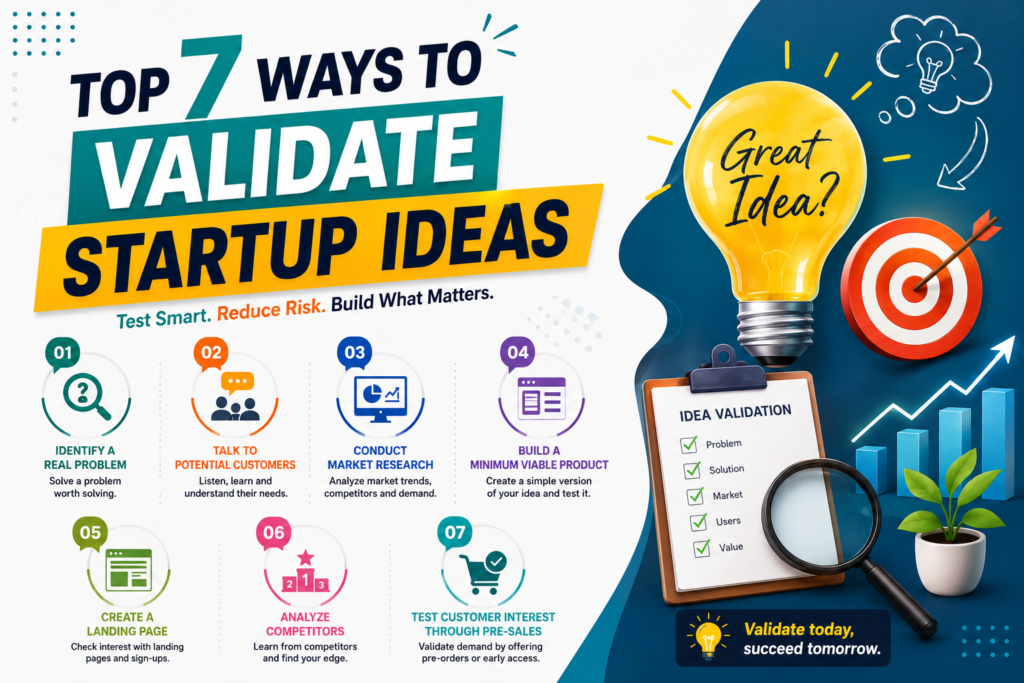
Top 7 Ways To Validate Startup Ideas
Every successful startup begins with an idea. However, not every idea becomes a successful business. Many entrepreneurs fail not because they lack passion or innovation, but because they skip one important step—market validation.
Before investing time, money, and energy into building products or services, founders must validate startup ideas to understand whether real customers actually need them. Validation reduces risk, improves decision-making, and increases the chances of building a sustainable business.
In India’s fast-growing startup ecosystem, smart founders know that great ideas alone are not enough. Real success comes from testing assumptions and gathering market insights before launch.
Whether you are a first-time entrepreneur or an experienced founder, learning how to validate startup ideas can save resources and prevent costly mistakes.
Here are the Top 7 Ways To Validate Startup Ideas before taking your startup to market.
1. Identify a Real Problem
The first step to validate startup ideas is identifying a genuine problem.
Many entrepreneurs fall in love with ideas rather than problems. However, customers pay for solutions—not concepts.
Ask yourself:
- What problem am I solving?
- Who faces this challenge?
- How frequently does it occur?
- Is the problem important enough for people to seek solutions?
Successful startups solve painful or urgent problems.
If a problem is minor or unclear, customers may not feel motivated to buy.
According to startup communities and entrepreneurial ecosystems, problem-first thinking remains one of the strongest foundations for startup success.
Entrepreneurs should focus on customer pain points rather than assumptions.
2. Talk to Potential Customers
One of the most effective ways to validate startup ideas is simply talking to people.
Customer conversations provide insights that research alone cannot deliver.
Instead of guessing, founders should conduct interviews and ask:
- What challenges do you face?
- How do you currently solve them?
- What frustrations exist?
- Would you pay for a better solution?
Direct conversations reveal customer behavior and expectations.
Many startups discover unexpected insights during interviews.
The goal is not selling your idea immediately but learning.
Honest feedback often helps founders refine products before launch.
3. Study Competitors and Market Demand
Competition is not necessarily bad.
In fact, competition often proves demand exists.
The third strategy to validate startup ideas involves market and competitor research.
Study:
- Existing competitors
- Their pricing models
- Customer reviews
- Product strengths
- Market gaps
Research helps entrepreneurs understand where opportunities exist.
If competitors already serve customers successfully, founders can identify ways to improve or differentiate.
Industry research platforms and startup databases can also help founders understand trends and investment activity.
Market understanding strengthens startup positioning.
4. Create a Landing Page or MVP
Modern startups no longer need to build full products before testing demand.
This makes landing pages and MVPs powerful tools to validate startup ideas.
A landing page explains your solution and measures interest through:
- Sign-ups
- Email subscriptions
- Waitlists
- Demo requests
- Feedback forms
An MVP—or Minimum Viable Product—is a simple version with essential features.
The goal is testing, not perfection.
Many successful startups launched basic versions before scaling.
Customer interaction with early versions provides valuable market evidence.
Building small helps founders learn faster.
5. Use Social Media and Online Communities
Social media has become an affordable startup validation tool.
Entrepreneurs can validate startup ideas by testing audience interest online.
Useful platforms include:
- Startup forums
- Entrepreneur communities
Posting content and engaging audiences helps founders understand reactions.
Questions to observe include:
- Are people engaging?
- Do they ask questions?
- Is interest growing?
- Would they join a waitlist?
Startup communities encourage idea sharing and networking, helping founders receive practical feedback and build early connections.
Community-driven learning often improves startup direction.
For entrepreneurs seeking networking and startup discussions, you can explore Startup Pe Charcha and learn more about their entrepreneurial ecosystem.
6. Test Willingness to Pay
Interest alone does not confirm business viability.
One of the most important ways to validate startup ideas is testing whether customers are willing to pay.
Many founders receive compliments but struggle with conversions.
A startup becomes sustainable only when customers see enough value to spend money.
Testing can include:
- Pre-orders
- Paid pilot programs
- Subscription sign-ups
- Early-bird offers
- Limited launches
Real purchasing behavior provides stronger validation than opinions.
Founders should avoid confusing attention with demand.
Revenue validation creates confidence.
For additional startup validation and fundraising resources, entrepreneurs often explore startup ecosystem platforms such as RaisePe or ArthSetu.
7. Gather Feedback and Improve Continuously
Validation is not a one-time activity.
Even after launch, founders must continue to validate startup ideas through ongoing learning.
Customer expectations evolve.
Markets change.
Products need refinement.
Founders should collect:
- Customer reviews
- User behavior data
- Support requests
- Satisfaction feedback
- Product suggestions
Continuous feedback creates better businesses.
Some of the most successful startups changed significantly after early market learning.
Adaptability is a startup strength.
Validation should remain part of long-term business strategy.
Why Startup Validation Matters
Many entrepreneurs skip validation because they fear criticism or delays.
However, failing to validate startup ideas creates bigger risks.
Startup validation offers several advantages:
- Lower financial risk
- Better customer understanding
- Smarter product development
- Improved marketing direction
- Higher success probability
Validation helps founders make informed decisions rather than emotional assumptions.
Testing early often saves resources later.
Entrepreneurs who validate strategically usually build stronger businesses.
Common Mistakes While Validating Startup Ideas
While trying to validate startup ideas, founders often make avoidable mistakes.
Common errors include:
- Asking leading questions
- Ignoring negative feedback
- Testing only with friends
- Building too much too early
- Assuming interest equals demand
Good validation requires honesty and openness.
Founders should seek truth—not approval.
Constructive criticism improves products and strategies.
Internal Resource: Learn More with Startup Pe Charcha
Entrepreneurship becomes easier when founders learn from communities and experienced professionals.
If you want startup networking, events, founder discussions, and entrepreneurial learning, visit the official Startup Pe Charcha Community. Their platform focuses on networking, startup discussions, mentorship, and ecosystem support for founders.
You can also explore their About section here:
About Startup Pe Charcha
Frequently Asked Questions (FAQs)
What does validate startup ideas mean?
It means testing whether a startup idea solves a real problem and has customer demand before launch.
Why is startup validation important?
Validation reduces risk and improves business decisions.
What is the fastest way to validate startup ideas?
Customer interviews and simple MVP testing are often the fastest methods.
Can startup ideas fail after validation?
Yes. Validation reduces uncertainty but does not guarantee success. Continuous improvement remains essential.
Conclusion
The Top 7 Ways To Validate Startup Ideas show that entrepreneurship is not only about creativity—it is about evidence and learning.
Before investing heavily, founders should validate startup ideas through customer conversations, market research, MVP testing, and continuous feedback.
Great startups are built through smart experimentation and adaptability. By validating ideas early, entrepreneurs increase confidence, reduce risk, and create businesses with stronger chances of long-term success.